Thursday, 31 December 2009

World Cup Woes


Picture, as I often do when there’s nothing on the telly, that you’re a wee Bushman in 19th century Okhahlamba.

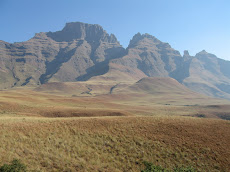
You go out for an invigorating eland hunt during the day, admiring the breath-taking mountain landscape. At night, you retire to your cave to paint your exploits and to explore the wonders of the Berg with a nubile maiden or two from Injisuthi. An occasional trip to Didima, for a spot of trading and some brisk traditional dancing, rounds off an idyllic lifestyle for any devoted fan of eland-related comestibles.

However, imagine your surprise one day when out stalking a reedbuck and, suddenly, you spot Shaka approaching at the head of a Zulu impi, with a look in his eye suggesting that he’s unlikely to be fobbed off with tea and biscuits.

Even the most dim-witted of a line of notably stolid cave dwellers would realize it was goodbye eland, hello doom.

A similar dread shivers down my spine when I consider next year’s soccer world cup; the thought of 450 000 fans brings me out in a cold sweat. I am plagued by nightmares of drunken phalanxes of lobster-pink hooligans.

How shall we survive the siege?

We already have the answer: never had I noticed such a prolific talent for forming clubs until I moved here.

Not least of these is the Probus Club. Almost everyone who is a member of any other club is a member of Probus. It is the club of clubs, the sanctum sanctorum, and the hub of the valley’s social scene. I may go so far as to say that you aren’t part of the valley until you join. I never thought that an evening once a month with exceedingly old people could be so much fun, but then I never thought that 50 would whiz by so quickly, either.

Some clubs don’t actively seek members, but you can do what everyone else does: form your own. At last count, book clubs outnumbered people who could actually read. The investment club has lost more shirts than the gambling club has legs.

My favourite is the ‘vegetable club’. On any weekday between 15:30 and 16:00, pay a visit to Hillbillies to buy your fruit and veg. Not only will you pay less, you can catch up on the skinner. (My reference to vegetables is not a personal slight of the members of this club.)

The list goes on. Before you know it, you will be happily occupied every day and night, flitting from one function to another activity, like my dream Bushman – and the yobbos will have gone home.

Star Trekking


When adventure calls, I camp on the escarpment, wait for darkness, and lie down with a pair of binoculars and a mug of whisky. I relive my boyhood fantasy: travelling between M-class planets, like a butterfly in a field of flowers.

Someone who did more than fantasize, and who entered Berg legend in the process, was Elizabeth Klarer. She was born in Mooi River in 1910, studied music and meteorology in England (a logical choice for a budding spacewoman), and learned to fly light aircraft (which, given later events, came in quite handy).

After reading George Adamski’s Flying Saucers Have Landed (1953) and Inside the Space Ships (1955), Elizabeth suddenly remembered that she’d been receiving telepathic messages from a friendly space alien called Akon since childhood. She at last replied, and arranged to meet him, riding her horse into our valley on 17 July 1955. She climbed over the Sphinx to Breakfast Stream, where she turned uphill to where the stream began.

You can still visit this rendezvous point today. When you reach a flat area, where the firebreak is burned every year, a 30- or 40-metre circle where nothing grows marks the spot. There are, of course, perfectly feasible geological explanations for the lack of vegetation, but let’s not spoil the story.

Akon allowed Elizabeth to take pictures of his spaceship. This was the start of a beautiful romance and, on 7 April 1956, Akon actually landed. He swept her up in his arms (or tentacles, or whatever) and carried her off to the mother ship, which was in earth orbit. In 1957, he took her back to his planet in the Alpha Centauri system, and they consummated the relationship. At the age of 47, she had a son, who stayed behind for his education while she came back down to earth.

The whole shebang – trip there, sex, pregnancy, delivery, and return trip – took a mere four months. Elizabeth took a little longer to publish the book, Beyond the Light Barrier (1980).

Just before Elizabeth died in 1994, Russell Tungay flew her to the spaceship’s landing site, free of charge, for one more look. Many would be surprised at the numbers who still visit the Berg every year, having met her or read the book, to pay homage to this strange place where Akon seduced his little earthling.

Whether or not you are a believer, the Galaxy has billions of stars and you too can enjoy a wonderful voyage, supine on your lawn with the lights out. Like Elizabeth, Ann Gray knows that the Berg is the perfect launch pad, and she has mooted an astronomy club. This is a glorious idea, so let’s support it: bring the binoculars, the Scotch, and your imagination.

Wednesday, 30 December 2009

Great Scot


Originally a Celtic, Gaelic-speaking people from Northern Ireland, the Scots raided the west coast of Roman Britain from the third century, and in the fifth century established the kingdom of Dalriada in Pictish territory. Scotland has had a bit of a rotten trot over the years since, but it developed into the planet’s greatest exporter of talented individuals, punching well above its weight. Its people have always been phenomenal inventors and adapters.

Take the bagpipe, which originated among the Hittites around 1300 BC. It is the Neanderthal of musical evolution – vaguely familiar, but hairier, with a heavy-browed lour and a tendency to drag its knuckles. It avoided extinction by migrating to Scotland in the late fifteenth century, where it found sanctuary.

On a cool February evening at Monk’s Cowl Country Club, the drone of a lone piper skirled gently down the first fairway. It then negotiated a sharp left at the flag pin, swooped back, and shot down my spine; my primitive soul (the Scots bit) tingled with anticipation. It was Rabbie Burns’ 250th birthday; a small band of Scots, and a larger number proudly claiming Scots ancestry, arrived in their kilts and tartan scarves/ties/underwear, and as I focused on the distant backdrop of cloud-draped mountains, I could smell Scotland in the damp air.

The agenda was a delight, starting with a splendid tribute to Burns by Bill Crichton, in his poetic lilt. Neil Crawford then treated us to a wonderfully surprising speech, followed by a superb poem composed and read by Denise Preiss. My favourite part, though, was the entry of the haggis. The piper led the procession, followed by Stuart Longmore – dressed unusually in long pants for the occasion: combed hair, even – reverently bearing aloft the ‘great chieftain of the pudding race’, and Robin Atkinson.

Frankly, the next bit was terrifying. In an Aztec-like scene, huge carving knife in hand, Robin addressed the haggis in authentic Burns dialect. ‘Fair fu’ your honest, sonsie face,’ he began. The tone and pace of the homage gathered urgency until, with glee on his own sonsie face, he plunged in the sacrificial weapon with the words, ‘trenching your gushing entrails bright, like ony ditch.’

(Note to diary: when you invite the Atkinsons for dinner, hide all sharp implements – and make no sudden movement.)

The haggis was delicious, especially with Scotch on it. (I had to explain to Bill Carter the difference between a ‘dribble’ and a ‘drool’.) This no doubt made the traditional Scottish dancing afterwards more confusing than normal, but I think we were all, by this point, having too much fun to notice.

The day was closer to Charles Darwin’s 200th birthday than to Burns’ 250th. I thought, as I reeled with Martin Goulding in a bizarre dance-floor contretemps, survival of the fittest was all well and good, but I was grateful that some things – pipes, haggis, whisky, (Scots?) – had hardly evolved at all.

Sunday, 27 December 2009

Honorary Mention


Bertram stands nervously before the king of France, frantically trying to argue his way out of having to marry Helena, a mere physician’s daughter. It isn’t going well. The king has the upper hand: ‘honours thrive, when rather from our acts we them derive’, he says.

All’s Well That Ends Well, and Bertram eventually does the honourable thing, but only after Helena tricks him into making her ‘with child’. Did two dishonours make an honour? Shakespeare clearly thought so, but I think it would be hard to pull off in real life.

In real life, too, ‘honourable’ isn’t the same as ‘honorary’. I mention this only by way of clarification, since I noticed a while back one of the Monk’s Cowl’s honorary officers being referred to as an ‘honourable’ officer. I know him, and I think even he winced, so let’s set the record straight.


We are ‘honorary’ only in the sense that we are unpaid. Call us grown-up boy scouts, if you like, but none of us is a Bertram (or a Helena, for that matter). In my own dib-dab-dob experience, no one would ever have called us honourable, particularly the girl guides.

Take away the woggles, the psychedelic neckerchiefs, and the keeping-a-fire-going-all-night badges, replace them with thinning hair, beer bellies, and eclectic tastes in whisky, and there you have us.

The leader of this rabble is Roy Strydom (you know: the short oke who always laughs at his own jokes, just in case no one else does). His second-in-command, Guy Widdecombe, by contrast and despite years of extreme effort, still can’t remember punch lines, so no one gets his jokes anyway. Greg Strydom and Brett Tungay are the reason I wasn’t able to call us Dads’ Army, but Graham Barry, from Wits End, is very definitely old. Peter Small, restaurateur and barkeeper extraordinaire, brings obvious benefits with his membership, while Roland Luke, maintenance manager at the Drakensberg Sun, does most of the actual work. Gappy Smythe knows more about our work than the rest of us combined, so, technically, I bring up the rear, but, for the purposes of this article, he agreed to keep me company.

You might have witnessed our meetings in the bar at Dragon Peaks. Don’t be fooled. ‘Conserve nature: pickle a squirrel,’ said the graffiti I saw once in London, and so it is that we engage in our purpose of nature conservation by getting seriously pickled on the first Tuesday of each month.

My favourite part is the vulture-protection programme. Vultures’ Retreat (above Gray’s Pass) is a good day’s walk, so it’s just as well that the South African Air Force fly us willingly up and down several times a year to monitor and count the vultures, their eggs, and their chicks.


For those of you who’ve never flown in an Oryx helicopter, especially piloted by fearless madmen with no pity for their passengers’ stomachs and advanced age, imagine an oversized biscuit tin hurtling and juddering in the void. If you think the noise at ground level is loud, you must hear the din inside.

This is nothing, however, compared to the ordeal of a young vulture’s maiden flight. Under the watchful tutelage of Mummy and Daddy gently cruising nearby, it peeks out of the nest to see the five-hundred metre drop just a step away. It then spread its wings, gulps, closes its eyes, and launches itself into the sky. Moments later, it opens its eyes. ‘I’m flying! I’m flying!’

The difficult bit, however, is landing back on the nest. This is the reason, I suspect, that baby vultures fly with their undercarriage down. This makes the series of crash landings, before they finally get the hang of it, even funnier.


Not so funny is catching these creatures. One day, when he or she insists on a romantic day out, take your loved one to a vulture restaurant, for a pleasant change, you understand. We have one at the top of Bergview.

It’s bad enough dumping a cow/horse/zebra/mother-in-law carcass on site, which is always ripe. Even worse, the first thing that a vulture does when caught is puke all over you. It pongs, let me tell you, and the time needed to carry the bird to the hide, tag it or fit a harness to it, and release it, make holding one’s breath physically impossible.

Much of our work takes place in the valley, however, and our little group forms an important link between Monk’s Cowl management and our residents. Usually in response to distress calls from landowners, we’ve caught and relocated crocodiles, dassies, yellowfish, and even the occasional motorbike.

In the park, we burn firebreaks, hunt Bushman paintings, identify indigenous trees and flowers, eradicate invasive aliens, and monitor the wildlife.

Then there is the Didima Challenge. Since this starts at an ungodly hour at Culfargie, we set up our bases, at various points along the route, the night before. I don’t know why Roy and I always get the Stable Cave assignment, but there it is. After too much pickling practice the night before, the two of us invariably look in worse shape than the arriving runners, who’ve already covered ten kilometres.

Spare us a thought, then, when you see us assiduously applying ourselves to the tasks at hand in the pub. We work hard for no reward, apart from the privilege of serving: scout’s honour.