Wednesday, 13 January 2010

The Mayan Mountain Myth


We’ve had comets, asteroids, the spawn of the devil, and an exploding sun, so it was only a matter of time before we had the latest Hollywood effort starring John Cusack, 2012, which dramatizes the adventures when the world ends (again) on 21 December 2012, a date apparently predicted by ancient Mayans.

An all-destroying pole shift is waiting for us, one of thousands that have already taken place in the earth’s history. Our distant forebears calculated in advance the previous one, and they escaped. With less than three years to go before the next one, many are already plotting how they will pull off a similar stunt.

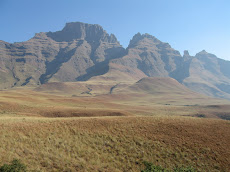
The good news is that, after the cataclysm, the only part of the earth still intact – indeed, above water – will be the Drakensberg Mountains. We’d be able to offer our guests a sea view – if the rest of the human race weren’t already mostly extinct, that is.

Hurray, you say, but wait. The bad news is that Mr Cusack and a few of his closest chums will survive, commandeer a boat, and set sail for our fair valley – but they will have no money to pay for accommodation, and they’re not going home.

If, like me, the idea of Americans taking over and civilizing our little community sends you all a-flutter, then you would agree that this just wouldn’t be cricket. Trouble is, our visitors’ boat will be one of the US Navy’s finest; not even Lily’s dogs would stand much chance against Howitzers.

Here’s my recommendation.

We appoint our most diplomatic representative (why does Dave Dowling leap to mind?) and send him to negotiate with President Obama. We tell him to insist that we appoint one of our own to oversee preparations. ‘After all,’ he could say, ‘we like Americans, blah, blah, but it is our valley.’

The president ponders this a moment, ignoring the nagging thought of Trojans and horses at the back of his mind, and says, ‘okay, but they must be competent, hard working, and, above all, as honest as the day is long. Hell, we don’t want this project to fail. Whom do you have in mind?’

‘Well,’ Dave continues, ‘it just so happens that our mayor and municipal manager are available.’

That should do the trick.

Tuesday, 12 January 2010

Is not this the carpenter?


Whatever expectations I had of retirement, I was wrong.

I left the city heady with dreams of rocking-chairs and pre-lunch beers. After a week, I was bored. After a month, I was worryingly close to brain death. Mrs Dragonfly had had enough. ‘You’ve moved from between my legs to under my feet,’ she said.

She’s all for honesty, that one.

I suspect my next step was what all men everywhere would do: I went to the pub. After some post-dinner whiskies, I discovered the comforting truth that, in a valley full of retired people, my inertia was familiar.

The old geezers blinked, mumbled encouragingly, and nodded in agreement. They’d all been goaded into new and hitherto undreamt-of hobbies. It didn’t really matter what, as long as they were out of the house, but carpentry seemed the way to go. Every one of them and his dog was an expert. Peak View Sawmills had seen them all – what stories the Grays could tell!

Besides, I thought, if it was good enough for Jesus’ dad (Joseph, not the other one), then who was I to argue? Apart from making really useful stuff, I could add a veneer of virtue to my reasons for buying all those wonderful tools.

The other great thing about woodwork was that I could start small (bird tables, shelves, walking-sticks), the failures could become objets d’art for the wife’s amusement (or, failing that, firewood), and I could work my way up (a double-storey house, for instance).

I’m not there yet, but, after three years, I’m no longer the worst carpenter in the valley. I have a chicken coop, two decks, and a ton of failures in the hearth to my name. I’m not at the level of Clive Parker, Graham Barry, or Roy Strydom, but nor am I plumbing the depths of the local league table. (I’m mentioning no names; even noms de plume are decipherable.)

If I were ever asked to talk about the afterlife, I could find a lesson in this.

My advice: when you arrive at the pearly gates and St Peter, Mohammed, or whoever asks you, get your hobby request in early, because it’s for sure that your wife will have no truck with clouds and harps. Take up something that will keep you occupied, and from under your wife’s feet, for ever.

Whatever expectations you have of heaven, you’re probably wrong.

Sunday, 10 January 2010

Mrs Dragonfly


What’s a female Dragonfly?

Isn’t it a damselfly, my sweetness?

No, it’s not! Now get back to the kitchen!

Ouch!

Whatever it is, I’m it. As the more perceptive of you have probably realized by now, Dragonfly and I have swapped roles this month: he’s cooking supper and I’m writing this article. Call it an exercise in mutual appreciation, if you like, but the truth is that Dragonfly has chauvinistically ignored the female contribution to this valley for far too long, and I aim at rectifying this appalling neglect.

I’m sure I speak for all long-suffering wives out there when I say that the men of our little community – blinded by their carpentry, gardening, or whatever other projects of boring-old-fart-ness that retirement entails – ignore the little things that can destroy domestic harmony.

Take my kitchen, for example. I love my cooking space, and I keep it clean and shiny. I read books, soup packets, magazines, and even stock-cube boxes. I look high and low for any ingredient missing from my chef’s heaven, no matter how obscure.

A recent effort called for five millilitres of Sambal Oelek. After five weeks, I proudly brought home 100 milligrams of the obscure mixture, only to discover that the recipe was nowhere to be found.

Thus it is, ladies that (I’m sure you sympathize with my desperation) when my dearest, with a glint in his eye, offers to cook, I reach for the Sauvignon Blanc, but I smile, nod, and make small suggestions. After all, I have a whole bag of butternut in the pantry and the five kilograms of carrots he bought at Hillbillies yesterday.

William was very persuasive. He said they were full of testosterone…

My beloved tries to follow instructions, but he uses his own method. It’s a male thing, I suspect. I withdraw, my stomach tightening at the thought of my kitchen being abused by a stranger.

He also said that butternut’s the perfect laxative, my darling. There’s nothing like releasing four prisoners before lunch, what?

I sigh, and I listen to the clang of pots and pans. I smell the onions frying and hope he remembers the salt; I just know he’s going to add too much chilli.

After an eternity, dinner is ready. The table is set, the food is good, and, yes, the kitchen is clean. He has even set the table and lit a candle.

I know what it is: it’s a nymph. Hey, there’s a thought: where’s that little diaphanous nightie of yours?

Saturday, 09 January 2010

Dulce et Decorum?


Our honorary-officer group occasionally takes time off from holding drunken meetings and counting vultures and gets down to serious work. Just the other day, we wandered through indigenous forest, arduously identifying trees.

As we were so employed, one of the chaps stopped and, in triumph, pointed at a tree, shouting, ‘Podocarpus latifolius!’

‘Are you all right, old chap?’ I said. ‘Have you been at the Harry Potter again?’

‘A real yellowwood, you can tell by the leaves’, he said, looking at me as if I were an imbecile.

While I’m conscious of the possibility of getting into seriously hot water with the Garden Club, let me make my point: what’s wrong with calling a real yellowwood a real yellowwood?

Botanists have not yet relinquished their Latin taxonomy. They argue that Latin is essential for communication between practitioners speaking different first languages. It is also important for classification. Inexplicably, lawyers claim the same thing, which is complete rubbish: they speak Latin because they love pretentiousness.

When the Normans invaded England in 1066, they established French as the language of court, destroying, almost overnight, the good work of Alfred the Great. English evolved anyway among the commoners, but the beau monde looked down at any upwardly mobile nob speaking anything but French.

More than three hundred years later, Henry IV was the first king since the Conquest to use English in all official communication, but it wasn’t until 1525 that a second powerful fetter on the language’s progress was finally broken, when William Tyndale translated the Bible from Latin into English. I know, I know, he was burned at the stake for his efforts (in my case, the bien pensants of the Garden Club may not consider that a bad idea).

Are all people who speak French or Latin either snobs or religious despots? Of course not, but I remain resolutely suspicious of attempts to use either when a perfectly good and intelligible English equivalent is available. It nearly always is.

Juliet told Romeo that ‘that which we call a rose by any other name would smell as sweet’. Whether we call it Solanum mauritianum or bugweed, it would stink as much.

For my part, ceteris paribus, I shall continue to tell parsley trees, starry rice-bushes, and horsewoods, not just by their leaves, but also by their wonderfully descriptive, English names: ‘tis the sweet and noble thing to do.

Friday, 08 January 2010

Excess Baggage


In one of her ‘green’ moods, Mrs Dragonfly decided last year that a compost heap was the way to go. As it turned out, it was a good idea, at least a million times better than the one about me helping with the washing-up, and not even on the same planet as the one involving a chicken, an axe, and me.

Not content with just our kitchen cuttings, she roped in the assistance of our guests, leaving a plastic tub in their cabins with the words ‘Organic Waste’. Before we knew it, we had a pile of rotting slime, putrefying happily in a smelly corner of the vegetable plot, and the weeds were looking healthier than ever.

Soon after, and not to be outdone, our Zulu domestic worker hit upon a commendable variation of the theme. Walking into the cabins one morning, we noticed not one, but two containers, one of which had, scrawled boldly on the side, Rubbish Candles Thank You.

‘For what?’ I wondered. ‘For putting them out of their sub-standard misery?’

My beloved’s reaction, in contrast, was one of indignation. ‘Do you know how much I pay for those candles?’ she asked.

Deeper investigation, however, revealed that, far from protesting that inanimate objects had feelings, too, or insulting our shopping habits, our enterprising maid had nothing more sinister in mind than sourcing some cheap (actually, free) floor polish for her home in Loskop.

Perhaps her ingenuity was infectious, because it wasn’t long before, like her, we began joining the dots and asking ourselves awkward environmental questions about the ‘rubbish’ we were throwing away.

Soon, we’d accumulated a shed-full of plastic tubs, but we’d run out of imagination. Did I really want to store my CD collection in them? We started buying our margarine in old-fashioned blocks, which was not only easier on landfill sites, but also considerably cheaper.

This was only the start. Berwin’s chicken was far more economical than the supermarket’s, as were the vegetables and milk at Hillbillies, and came with a fraction of the plastic packaging. Not only that, but we saved on the fuel to Ladysmith/Estcourt/Pietermaritzburg. Beer is far more sociable in quarts, not to mention less wasteful. We print on both sides of the paper. The list goes on.

It occurred to me that being aware of excess, and either eliminating it or recycling it, not only helped save the planet, it also saved us money. ‘Green’ need not mean ‘uneconomic’. This may be one good thing to emerge from the financial crisis, if we can hold on to the good habits when things improve.

My nearest and dearest continues to look for new ways of reducing our carbon footprint, bless her crusading heart, but I noticed her sharpening the axe again yesterday.

‘Oh dear,’ I thought. ‘Whose head this time?’

Sunday, 03 January 2010

The Writing on the Wall


Next time someone spoils Happy Hour by talking of land claims, casually mention that the first people arrived in our valley 120 000 years ago. They stayed 46 000 years, until the eruption of Mount Toba in Sumatra all but wiped out mankind. They were the forebears, not only of Bushmen, but also of Europeans, Asians, and Africans. In the final analysis, we all have an ancestral entitlement to this land.

Bushman DNA parted ways with everyone else’s 10 000 years later, when humans began spreading so far from each other that they were not to meet again until recently. On their separate journeys through time and geography, they took with them a by-product of the volcanic catastrophe: a budding self-awareness. Jewellery, 70 000 years old, was found in a Western Cape cave, hinting at cave-paintings from 35 000 years ago in Europe and 27 000 years ago in Namibia being part of a common and much older artistic heritage.

Not only is this artwork astonishingly beautiful, it is a ritualized record of the dreams, revelations, and messages of the shaman. He was the conduit to a spirit world occupied by ancestors.

In Europe and Asia, pictures were replaced by the exquisite written language of the Book of the Dead, the Vedas, and later holy texts; shamans evolved into priests and the spirit world morphed into a realm of gods: über-ancestors.

Not so in Africa, where the Bushmen preserved the old ways, migrating to our province 20 000 years ago, and to our valley 6 000 years ago. Resources were plentiful, war was unnecessary, and the hunter-gatherer reproduced only at a rate that maintained numbers.

Conditions were harsh, so few of the paintings that survive in the Drakensberg are older than 2 000 years. The Bushmen made up for evanescence with sheer volume. Today, there are more cave-paintings here than at all other known sites around the world combined.

Bantu farmers arrived in AD 300, spreading from the coast. They bred rapidly and the Bushmen retreated to a diminishing territory below the escarpment, where eland roamed and crops could not be raised. Shaka Zulu in the 1820s and the white man in the 1840s then sealed the Bushman’s fate. The eland were hunted almost to extinction. Some Bushmen trekked west, where either they interbred or they were mercilessly destroyed, while others climbed into Lesotho, where they were safely absorbed. As far as we can tell, the last Bushman left in 1926, flushed out of his last hiding place at Eland Cave.

In this valley, a civilization thrived for millennia before Europeans evolved pale skin and blue eyes, and before the Bantu herded cattle. When Europe was an uninhabitable wasteland of ice, and Africa was a primitive place of heat and death, a small, gentle people with short lives and long memories dwelled among the forests, rivers, and mountains that we now ‘own’.

Our mountains are the cathedral of the Bushmen, where their scriptures are written on the walls. Where are their land claims?

Corrupt Revolutionaries and Parties


Did you notice the municipal by-election? It is now over, and my fifty bucks says that the IFP candidate’s promise of free KFC rounders to all who voted for him handed it him on a platter. The ANC might have fought a slightly less dishonest contest, but I suspect that a people of whom a decent proportion put their beds on bricks and stick banknotes on brides’ headdresses would always swing the other way.

This fills me with gloom. The ANC may not be the most inspirational of challengers, and its enduring legacy may be as the party who inherited a country and spent most of the loot on Mercedes Benzes, but the IFP quite simply causes the toes to curl.

It’s difficult to think too long and hard about the situation without steam hissing from my ears. The IFP has had the upper hand at Okhahlamba for a number of years and all they’ve managed to do is lurch from one crisis to another, to line several high-ranking officials’ pockets (and their families’), and to get through more managers than Jacob Zuma has wives.

The DA is hardly a more palatable choice, either. Outside the Champagne Castle Hotel, tied with bloudraad to a tree, a DA poster hung untouched since the 1999 general election. It recently fell off, a victim of the elements, tired of proclaiming that ‘the DA delivers’ under a picture of a smiling Tony Leon. We all know the truth: the DA is adept only at making enough of a nuisance of itself until its leaders get cushy jobs in far-flung paradises.

We shall have more of the same in next year’s municipal elections: more hollow promises, more T-shirts, and more greasy food.

Enough is enough, I say. In true Obama-esque lingo, let me say, ‘It’s time for change!’ Those of you looking for something completely different, for free braaivleis on Heritage Day, and for a mayor who rides in a bakkie (bodyguards on the back), you would look far and wide to find a better candidate than me.

My new offering, the Counter-Revolutionary Action Party, will soon be knocking on your door, canvassing your vote, and making wild pledges that will make you drool in anticipation.

When you see my posters, remember all I’ve said. Forget the ANC (African Naked Corruption), the IFP (In For Profit), and the DA (Dull Annoyance), and vote CRAP!

Friday, 01 January 2010

Of Leopards and Men


After seven years as the officer in charge of Monk’s Cowl, the valley gave Alan Howell a farewell that he would not easily forget.

It was the evening of 14 March. Paul and Sue Ross arrived for supper at the gate, which was locked, so Alan decided to walk from his house, down the unlit road, to open up for them. It was a cool evening. Gentle rain had fallen that afternoon and the moon was shrouded in cloud, but there was enough dim light to find his way. He had walked this road a thousand times.

As he approached the boom, he froze: not fifteen metres ahead, silhouetted against the spreading beam of the security light, was the shape of a very large cat. It, too, stopped, and the two were locked, eyeball to eyeball, for a couple of heartbeats that passed in super-slow motion.

Thump.

Alan’s brain processed information at a rate that would have made IBM’s eyes water. ‘Okay,’ he thought, ‘it can’t be a serval: too big, the ears aren’t pointed, and the tail’s too long. Crikey, it’s a leopard!’

Thump.

The leopard, meanwhile, was doing its own calculations. ‘Apple sauce,’ it thought.

As if in response, Alan’s next reflex was defence. He reached to his belt: just his penknife. In an instant, he was transported back six thousand years, clad in animal skins, alone, and thoroughly exposed. He looked around for a rock.

Thump.

The leopard, meanwhile, calling on inherited memories of its own, recognized the movement of Alan’s hand. ‘Sorry, but some other time, human,’ it thought, and took off at pace up the hill, and into the dark.

Thump… thump… thumpthumpthumpthumpthump…

Adrenalin pumping and not daring to look behind him, Alan ran to the gate. After opening, Paul said, ‘Geez, you look psyched up; I’ll race you back to the house.’ ‘No ways, Bru,’ said Alan. ‘Let me in, right now!’

It’s a great story – Alan will tell it to his grandchildren as they sit around the fire on cold Canadian evenings, reminiscing about his halcyon days in Africa – but it’s not new. The funniest Bushman painting is in a cave near Didima Gorge. It shows a Bushman running, stick-legs in typical sprinting pose, closely pursued by the gaping jaws of an enormous leopard. I came across it once with Graham Barry, who commented in his dry way, ‘this wasn’t a self-portrait.’

We’d known for a while that a leopard was around, but the gratitude Alan feels at having met it will be mixed with thankfulness that, unlike many ancient Bushmen before us, he lived to tell the tale.