
Next time someone spoils Happy Hour by talking of land claims, casually mention that the first people arrived in our valley 120 000 years ago. They stayed 46 000 years, until the eruption of Mount Toba in Sumatra all but wiped out mankind. They were the forebears, not only of Bushmen, but also of Europeans, Asians, and Africans. In the final analysis, we all have an ancestral entitlement to this land.
Bushman DNA parted ways with everyone else’s 10 000 years later, when humans began spreading so far from each other that they were not to meet again until recently. On their separate journeys through time and geography, they took with them a by-product of the volcanic catastrophe: a budding self-awareness. Jewellery, 70 000 years old, was found in a Western Cape cave, hinting at cave-paintings from 35 000 years ago in Europe and 27 000 years ago in Namibia being part of a common and much older artistic heritage.
Not only is this artwork astonishingly beautiful, it is a ritualized record of the dreams, revelations, and messages of the shaman. He was the conduit to a spirit world occupied by ancestors.
In Europe and Asia, pictures were replaced by the exquisite written language of the Book of the Dead, the Vedas, and later holy texts; shamans evolved into priests and the spirit world morphed into a realm of gods: über-ancestors.
Not so in Africa, where the Bushmen preserved the old ways, migrating to our province 20 000 years ago, and to our valley 6 000 years ago. Resources were plentiful, war was unnecessary, and the hunter-gatherer reproduced only at a rate that maintained numbers.
Conditions were harsh, so few of the paintings that survive in the Drakensberg are older than 2 000 years. The Bushmen made up for evanescence with sheer volume. Today, there are more cave-paintings here than at all other known sites around the world combined.
Bantu farmers arrived in AD 300, spreading from the coast. They bred rapidly and the Bushmen retreated to a diminishing territory below the escarpment, where eland roamed and crops could not be raised. Shaka Zulu in the 1820s and the white man in the 1840s then sealed the Bushman’s fate. The eland were hunted almost to extinction. Some Bushmen trekked west, where either they interbred or they were mercilessly destroyed, while others climbed into Lesotho, where they were safely absorbed. As far as we can tell, the last Bushman left in 1926, flushed out of his last hiding place at Eland Cave.
In this valley, a civilization thrived for millennia before Europeans evolved pale skin and blue eyes, and before the Bantu herded cattle. When Europe was an uninhabitable wasteland of ice, and Africa was a primitive place of heat and death, a small, gentle people with short lives and long memories dwelled among the forests, rivers, and mountains that we now ‘own’.
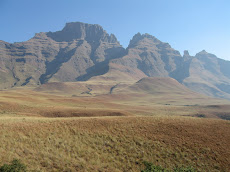
Our mountains are the cathedral of the Bushmen, where their scriptures are written on the walls. Where are their land claims?



No comments:
Post a Comment