Sunday, 04 July 2010

The Age of Reason

Our esteemed editor’s mysterious hint that Dragonfly was soon to metamorphose into a seagull – a kind of Jonathan Livingstone – was a reference to our decision to go sailing or, as Martin Goulding calls it, to ‘suck off into the fun-set’.

I tip my skipper’s cap to those of our little community who have congratulated us on this new adventure and brought a tear of gratitude to my eye with little endearments like ‘I had a friend die at sea once’ and ‘you’re mad’.

Alan Leggitt assured me that it was a ‘middle age’ thing and offered to take me for a walk in the mountains so that he could share with me his lifelong observation of such things. This was the sweetest friendliness.

Intrigued, I consulted my trusty Oxford English Dictionary, which said merely that middle age was ‘the period between youth and old age, about 45 to 60’. This can’t be right; it sounds too arbitrary. If so, then my children are youths – although they’ve already produced four grandchildren and a half – and most of the Probus committee, and almost the entire walking club, are geriatric.

Contrary to Mrs Dragonfly’s assertions, I remember childhood. What was so exciting about it? In a word: potential. Kids see few limits to it. I wanted to be an astronaut, or a fireman, or a lawyer (thank God I got over that one), and so on. I changed my mind whenever I discovered something new.

What’s so bad about being old? I suspect that the answer would be ‘limitations’. He's too old or he can't do that any more. He used to be able to, but no more. There's no point starting a new career; he doesn't have time on his side. He's paid his dues and he didn't get what he expected. He doesn't like it, but that’s his lot in life.

Perhaps middle age is the time between these two states, a shift so slow, so incremental, we don't notice it. We start at one end and end up at the other.

Looked at with any objectivity, middle age ought rather to be a celebration of having the experience and freedom finally to begin growing, not declining. Alan and Muriel still look forward to tomorrow, I’m sure, but maybe others slide down the hill from youth to old age, instead of climbing it.

It is both sad and exciting, and we shall miss you and this mountain paradise, but, when we spot the seagulls, we shall think of you.

Fire on the Mountain

Hlongwane has been burning firebreaks for 30 years. Sixty years old, and he’s seen it all. It’s a chilly June morning at the top of Keartland’s Pass, and a phalanx of fire warriors straggles up with fire beaters, water-packs, and paint tins full of petrol and old mealie cobs. The sub-induna has the privilege of carrying Hlongwane’s backpack, complete with little wheels and a picture of ‘Mickey Mouse and his Friends’.

Hlongwane shouts at his friends all the time. This is the only way his orders can be heard above the roar of the furnace that precedes us as we make our slow way along the Sunset Trail. I think, also, that he finds it easiest to keep his rabble of arsonists in check under the cosh of his constant, booming voice. When he uses his walkie-talkie, he signs off with an ‘Out!’ that would scare the living daylights out of any fire-god who’d dare have impure intentions today.

Smoke billows in enormous clouds, and the heat sears at anywhere closer than throwing distance. Occasionally, the wind shifts and flames approach, like a swarm of bees that has seen something that bees like a lot. Hlongwane never hesitates: at the first sign of a contrary wind, he barks like a Baskerville hound, orange overalls run around like madmen, and the fire is out. A short breather, the wind dies down, and we’re off again.

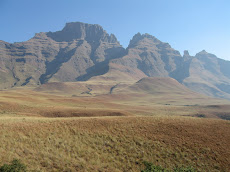
Eventually, we reach the Matterhorn. Do yourself a favour one day and walk up to this point. The view is truly magnificent. The Little Berg drops vertiginously, hundreds of scary metres, and the whole of our little valley, all the houses, all the resorts, are spread out below.

We have no time to admire the vista; the fire is turning down to the north and we need to rush over the ridge like lemmings to stay ahead. If I had time to think, I’d be wetting myself, but we make it. When we reach the bottom, and the fire is out, my knees begin shaking – how they do this every year and never have any accidents or injuries is a mystery.

I look back up the mountain, seeing the neat firebreak all the way down. It is strangely and immensely satisfying to see. Hlongwane looks too, and then smiles at me. ‘How are you, Sir?’

‘I’m glad you’re old, Mickey,’ I say.