Monday, 03 May 2010

What veiled form sits on that ebon throne?


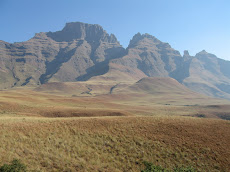
When JRR Tolkien wrote The Hobbit and The Lord of the Rings, he drew inspiration from many places: Bilbo Baggins could have come straight out of Beowulf; Odin’s Draupnir was the magical golden ring that bound them all, shedding eight replicas of itself every ninth night; the Misty Mountains, by some accounts, were the Drakensberg Mountains; and the ancient Numenorean throne was Odin’s Hlidskialf, from where he could see everything that happened anywhere.


Through these connexions, all of us in this valley are linked with a history of story-telling stretching back as far as our imagination will take us.


I too have a high throne – although my name for it is the decidedly unromantic ‘Thor-seat’ – and my thoughts travel across the aeons and landscape of these peaks like Odin’s ravens, returning to me each evening; also like him, I have two hounds, but they tend to steer clear, mainly because of the smell.


Odin allowed his wife to sit here also, which might have been a mistake, if you ask me. Displaying a complete disrespect for the sanctity of such things, Mrs Dragonfly removed the Beano collection stacked reverently next to my throne and replaced it with those truly dreadful women’s magazines, forcing me to contemplate high heels with my denims next winter and to calculate whether my star sign is a lion or a rabbit or a flipping sparrow. One of these days, Odin and I shall have to have a little god-to-insect chat about it all.


What the goddesses of this valley fail to appreciate is that men judge other men by the quality of reading material in their littlest rooms. I expect to find computer journals next to Neil Crawford’s lavatory or sheet music piled on Fred Knowles’ cistern, and, when I don’t, it’s like discovering that hobbits and elves and wizards no longer wander Middle-earth.


Tolkien weaved magic from the threads of myth and legend, breathing life into his heroes and villains from the wellspring of our inherited fantasies. These survive still in the fastnesses of our high escarpment, in the spray of their streams and waterfalls, and in our secret places, where we relive these fables and make up new ones as we daydream on our thrones of power.


Damn! Here she is now, banging on the door.


‘Hurry up! How much longer are you going to be in there?’

Saturday, 01 May 2010

The Old and the Dutiful


My brother visited us three years back. In the old country, he and I were raised in the West Country, with the slow-R accents, the gardening analogies, and a suspicion of anyone from the Forest of Dean. It was his first time in the Berg, and I don’t see him often, so I wanted him to enjoy it.


I suspect that we all like to portray our little valley in its best light, despite the dreadful other things for which our country is famous, and I was no exception. We’re like mothers, aren’t we, wiping their little brats’ noses and licking their wayward fringes flat before meeting the vicar, hoping he won’t notice that their offspring is actually the spawn of the devil.


Anyway, the weather was glorious, the dogs were on their best behaviour, and my brother’s girlfriend managed not to be bitten by a snake, which, given her paranoia of the untamed dark continent, was a major victory.


Sensing I was on a roll, I risked introducing them to the locals at Dragon Peaks’ Wednesday-night special. As we walked into the bar, my brother gaped.


‘I’ll be jiggered,’ he said. ‘It’s Emmerdale Farm!’


This comment hit home: soap operas – I can still hum the theme tune from The Archers – were the mainstay of our mum’s daily entertainment. He was right: in this corner, three old codgers talked about carpentry; at that table, the ladies were wondering whether potatoes were bad for pigs; and the Red Wine Brigade had arrived, waving bottles as if there had been a recent drought.


There were no green Wellington boots or Land Rovers, but hiking boots, shorts, and scruffy T-shirts were adequate to the analogy: big white men in big white bakkies; Ambridge-under-mount.


‘Yeah, I could write a daily 12-and-a-half-minute episode of this place,’ I conceded, ‘and never run out of ideas.’ As if to underscore this, as we poured our beers, I told him my embellished version of Elizabeth Klarer’s alien-abduction tale. In this account, two of the locals witness Akon’s ship landing by Breakfast Stream.


‘Who do you reckon made it, then?’ asked one. ‘Ooh, Massey-Ferguson, I shouldn’t wonder,’ said the other. ‘Well, tain’t much good, then. Look! It don’t cut the grass, it burns it.’


Peter Small interjected, wiping his hands on a towel, ‘but that’s a true story, isn’t it?’


‘Yes,’ I said. ‘Of course it is.’